
Reflecting on Tribal History and Engagement

By Angie Rodriguez-Arriaga, West Yost, and Annalisa Kihara, State Water Resources Control Board
This article contains and answers the following:
- Inclusive decision-making in water resources
- Building relationships with Tribal communities in water projects
- DEI initiatives in groundwater management
- What role does DEI play in groundwater and water quality management?
- Why is Tribal history important for water professionals to understand?
In early November, the GRA Diversity, Equity & Inclusion (DEI) Committee coordinated a training on California Tribal History, Relationship Building, and Engagement at West Yost’s Davis office. Groundwater Resources Association (GRA) GRA leadership, including executive officers and directors, joined West Yost Team Members and DEI Committee Members for a day of learning and reflection.
The DEI Committee was originally formed during the summer of 2020, following nationwide conversations about equity and representation. What began as a task force eventually became a standing committee, supported by GRA’s first DEI Executive Officer. Since then, the Committee has worked to ensure that all voices have a seat at the table in California’s groundwater conversations by evaluating current practices, improving representation, and supporting inclusive event planning and leadership.
These actions help build trust and support stronger long-term partnerships.
The idea for this training emerged directly from wanting to include all voices at the table. When the committee began searching for Tribal water history and engagement training designed for water professionals, we found very few existing options. After exploring several possibilities, we partnered with the Watershed Solutions Network (WSN) to co-develop a session specifically tailored for the GRA community.

Facilitators Debbie Franco (Watershed Network Solutions) and Mark Franco (Traditional Lifeways) presenting the tribal engagement training at the Davis WY Office.
WSN is a network focused on collaborative land and water stewardship across California. Their work centers on building cross-sector connections, strengthening regional partnerships, and helping leaders take informed action at the landscape scale. The training was facilitated by Debbie Franco, CEO of WSN, and Mark Franco (Traditional Lifeways), former Headman of the Winnemem Wintu Tribe. Debbie and Mark noted that although they were excited to offer this overview, there are still limited opportunities statewide for Tribal-led education, highlighting the importance of continued learning across agencies, organizations, and consulting firms.
Throughout the workshop, facilitators shared an overview of California’s Tribal history, including the unratified treaties, early state laws, and federal policies that continue to influence Tribal sovereignty, land access, and modern water decision-making. This context helped illuminate why engagement practices look the way they do today, and how water professionals can begin shifting toward ongoing relationships grounded in respect, listening, and continuity.
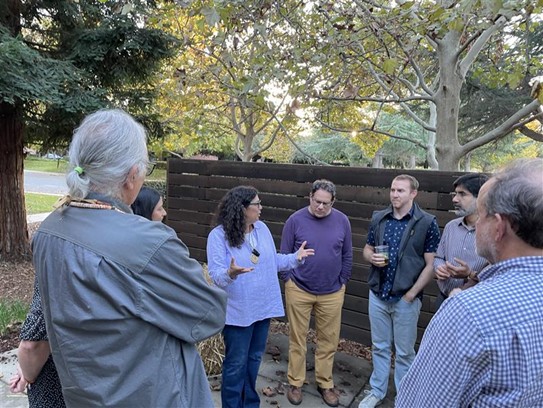
Facilitators Debbie Franco (Watershed Network Solutions) and Mark Franco (Traditional Lifeways) concluding the tribal engagement training at the Davis WY Office.
For West Yost Team Members, the training provided space to reflect on how our project work fits within a longer history of stewardship. The discussion underscored the importance of making space for Tribal perspectives early in project development when goals, assumptions, and frameworks are first being shaped.
Participants left with practical steps to carry forward: learning about local Tribal communities, creating opportunities for collaboration earlier in the process, and taking time to listen. These actions help build trust and support stronger long-term partnerships.
The discussion underscored the importance of making space for Tribal perspectives early in project development when goals, assumptions, and frameworks are first being shaped.
As both GRA and West Yost continue to support DEI efforts, events like this reflect a shared commitment to thoughtful and informed engagement in the water space. Especially at a time when DEI programs are being reduced in other industries.
If you are interested in learning more about these topics or getting involved, the GRA DEI Committee welcomes connections (email Annalisa or Angie). Additional reflections will be available in a forthcoming HydroVisions article summarizing the training.

About the Authors
Angie Rodriguez-Arriaga is a Geologist at West Yost Associates, where she supports groundwater sustainability, hydrogeologic analysis, and data-driven reporting for agencies across California. She is a co-lead of GRA’s Diversity, Equity & Inclusion Committee and is passionate about uplifting diverse voices in water management. Angie is committed to making groundwater science more accessible, equitable, and collaborative.
Annalisa Kihara, is the Assistant Deputy Director in the Division of Water Quality at the State Water Resources Control Board where she oversees several critical programs within her branch, including groundwater monitoring, cleanup, protection, and permitting, as well as sustainable water programs such as recycled water and stormwater capture and use. She brings her strong commitment to equity to her role as the GRA DE&I Officer, serving as a key voice on GRA’s Executive Committee.