
Built to Endure: Resilience as a Reliability Guarantor

By Andy Bochman, Resilience Strategic Lead
This article contains and answers the following:
- How can utilities assess recovery times following worst-case events?
- Why is identifying critical infrastructure vulnerabilities and single points of failure important?
- Resilience considerations for shaping capital improvement priorities
- What level of essential service must utilities maintain during major disruptions?
- What role does resilience planning play in ensuring long-term service reliability?
On a blue-sky day, reliability can look almost effortless.
The power is on. Treatment chemicals arrive when expected. Pumps, controls, communications, and SCADA systems are working. Operators have the information they need. Water moves where and when it should, chemicals arrive on time and treatment processes perform as designed, and customers receive the service they expect.
That is what a reliable utility looks like.
But what about when the sky turns grey or black, when wildfire interrupts grid power, a flood affects multiple facilities at once, or a cyberattack makes operators question whether they can trust what they’re seeing on their screens? Suddenly, assets that performed reliably in more optimal conditions may not be able to keep the system operating at the minimally required level of service (LOS).
That distinction exposes an important gap between how utilities measure performance today and how they plan and prepare to sustain it tomorrow.
Reliability is how consistently a utility meets its level-of-service (LOS) targets over time. It looks backwards to tell leaders and stakeholders how their system has performed.
Resilience looks forward and asks whether critical assets and the systems connecting them can absorb disruption, adapt and recover when external conditions become ever more challenging.
They are now two sides of the same coin: future reliability is decided by today’s resilience investments.
As West Yost’s Resilience Strategic Lead Andy Bochman frames it, under normal conditions, utilities aim for target LOS, including water quality, pressure and fire flow. During a major event, the priority is maintaining a pre-defined minimum LOS for essential services and customers. If service is lost entirely, the time required to achieve partial and then full restoration becomes critical.
This makes resilience a community-service decision: what must be protected first and best, who does it serve, and who decides?
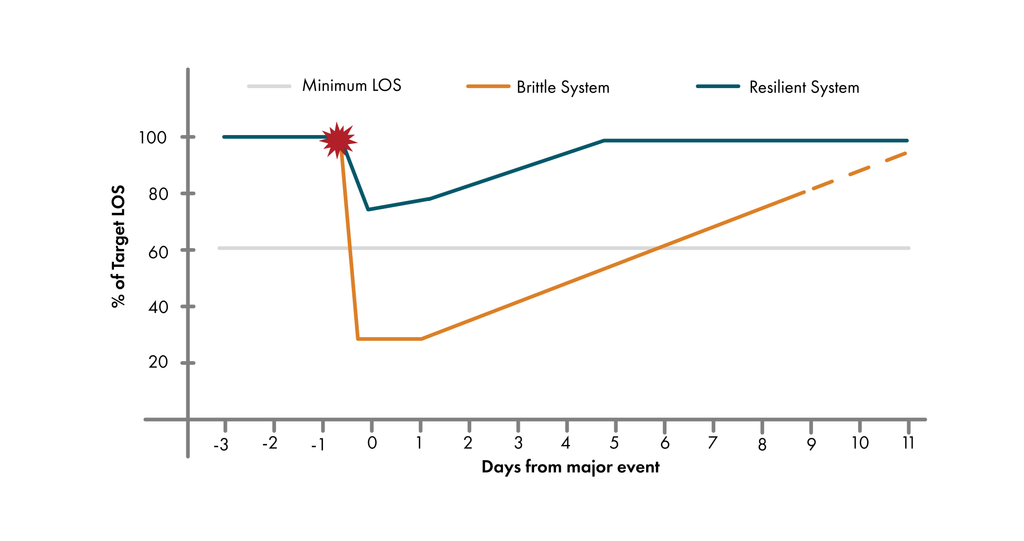
The figure above depicts what it means to have invested in resilience ahead of an event, or to have failed to do so. Reliability is the top line; resilience determines the depth and duration of the dip.
Depth: how far service falls. It depends on margin, hardening, ability to isolate, etc.
Duration: how long until full-service returns. Driven by speed of restoration, spares, manual operation, mutual aid, practiced plans, etc.
Area: depth x duration. This reflects total loss of service, and the many costs in terms of lost revenue, emergency spending, impacts for businesses and critical facilities downstream. The dashed tail keeps adding cost every day it stays under 100.
Reliable Parts Do Not a Resilient System Make
Consider two well-maintained pumps, for example. Both may provide excellent redundancy yet still share vulnerabilities that allow a single disruption to disable both. Resilience requires looking beyond individual assets to the dependencies connecting them.
Bochman seeks to identify all critical dependencies and calls single points of failure the enemy of resilience. They might be a person, supplier, software platform, power source or physical asset. What matters is the consequence when they fail, disappear, or become unreliable.
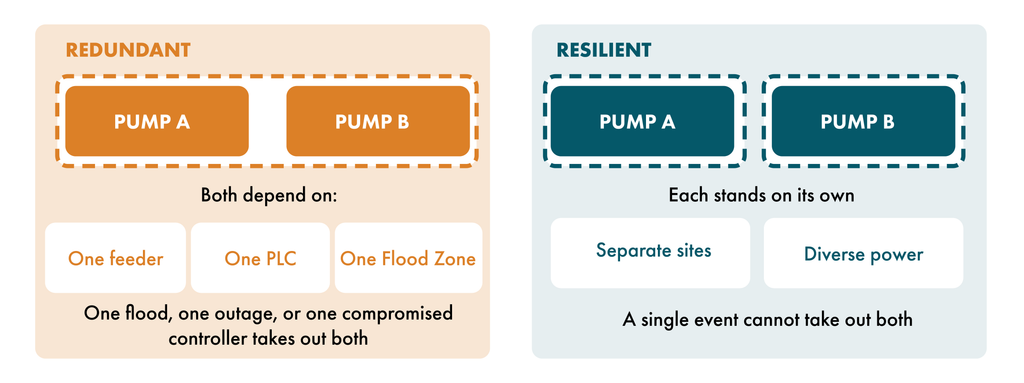
This figure shows how two identical assets, depending on how and where they are configured, can either greatly boost resilience (as shown on the right) or add very little or none at all (as you can see on the left).
Turning Resilience into Design Requirements
Resilience becomes actionable when it shapes design and investment decisions. Four principles help translate that objective into practice:
- Define performance targets. Establish minimum service levels, acceptable downtime and recovery objectives
- Plan for all hazards. Consider cyber incidents, power failures, extreme weather, seismic events and supply disruptions
- Design for continued operation. Establish safeguards and alternatives that maintain essential functions when primary systems fail
- Address critical dependencies. Identify shared vulnerabilities across infrastructure, power, communications, vendors and digital systems, and plan for their disruption
Applying these principles to master plans, capital improvement programs, and facility upgrades helps utilities prioritize investments based on consequences, strengthen operational continuity, and establish measurable resilience outcomes.
Preserving Capabilities as Technology Advances
AI and automation can help stretched utility workforces, but they can also create new dependencies. Bochman raises the risk of cognitive offloading: if software increasingly performs work through which younger staff develop judgment, who will carry that expertise forward? And if SCADA or other digital systems are unavailable or untrustworthy, could operators still deliver essential services? Manual operation requires people, local controls, authority and practice, lots of practice.
The principle is simple: Don’t optimize away the human capabilities you will need when automation disappears.
Questions for Utility Leaders
The test of resilience isn’t whether a utility has planned for every possible disruption. It’s whether leaders understand what must keep working, what could take it down and how the organization would respond.
These questions provide a practical place to start:
- What is the minimum level of service we must maintain during a major disruption, and who gets it first?
- How long would it take to restore full service after our worst plausible events?
- Which critical assets share a single point of failure, such as power, location or controls?
- Would our capital improvement projects rank differently if resilience were explicitly scored?
Today’s reliability numbers tell utility leaders how well their systems have performed in the past. Today’s resilience decisions determine how well those systems will perform in the future when blue skies turn gray or black and how effectively they will continue to serve the communities that depend upon them.

About the Author
Andy Bochman is the Resilience Strategic Lead at West Yost, where he provides strategic guidance on infrastructure security and resilience to water sector organizations, as well as senior U.S. and international government and industry leaders. A frequent speaker, writer, and trainer, Andy is the author of Countering Cyber Sabotage: Introducing Consequence-based Cyber-Informed Engineering and a former Atlantic Council non-resident senior fellow. His upcoming book, PREPARE: Welcome to the Age of Infrastructure Resilience, explores cyber, AI, climate, and physical risks to critical infrastructure, including water and wastewater utilities. His previous experience includes roles with the U.S. Air Force, IBM, the Chertoff Group, and Idaho National Laboratory.